


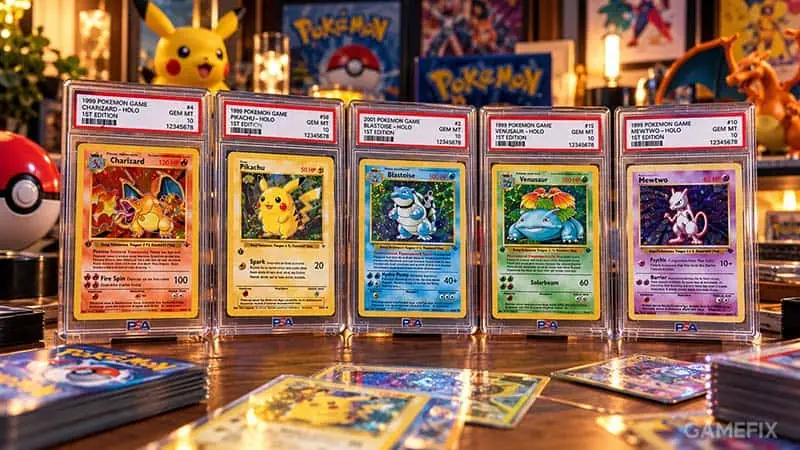
Why are Pokémon cards so expensive? The answer comes down to much more than age or rarity alone. Some cards are worth only a few cents, while others have sold for millions of dollars because scarcity, condition, grading, collector demand, character popularity, and historical importance can all affect their value.
Understanding why Pokémon cards are so expensive also explains why two cards featuring the same Pokémon can have completely different prices. A common modern card may exist in huge numbers, while a tournament prize or PSA 10 promotional card may have only a handful of comparable copies available.
Why Is One Pokémon Card Worth $5 While Another Is Worth $5 Million?
A Pokémon card does not become valuable simply because it is old.
Millions of cards were printed for regular sets, and many survived in large numbers. If collectors can easily find a particular card today, there is little reason for its price to rise dramatically. Even an older card can remain inexpensive when supply comfortably meets demand.
The opposite happens when a card was difficult to obtain from the beginning. Tournament prizes, competition promos, limited Japanese releases, and extremely difficult booster pulls may exist in much smaller quantities. If thousands of collectors want one of those cards but only a handful of desirable copies are available, prices can climb quickly.
That basic relationship between supply and demand sits behind almost every expensive Pokémon card.
Rarity Matters, but Not All Rarity Is Equal
The word “rare” appears on plenty of Pokémon cards, but collector rarity goes much deeper than the symbol printed on the card.
Some cards were available in normal booster packs. Others were handed only to winners of specific competitions or tournaments. Pokémon trophy cards are a good example. PSA notes that these cards are particularly significant because of their limited distribution and the unusual way they entered the hobby rather than simply being sold to the public.
That distinction matters enormously.
A card with a low pull rate may still have thousands of copies in circulation. A competition card distributed to only a small group of winners starts with a completely different level of scarcity.
This is one reason cards such as Pikachu Illustrator sit in a different category from most retail Pokémon cards.
Condition Can Completely Change the Price
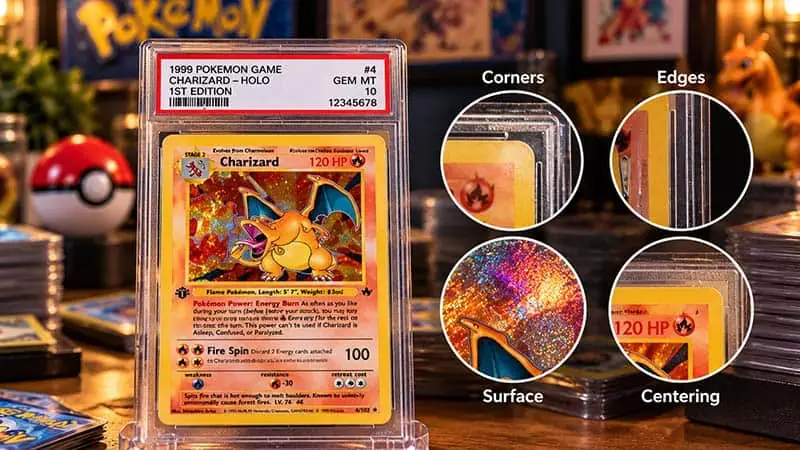
Two copies of exactly the same Pokémon card can sell for dramatically different amounts.
Collectors look closely at corners, edges, surface quality, print defects, scratches, centering, and other imperfections. Professional grading companies examine these characteristics and assign a numerical grade.
PSA, for example, describes a PSA 10 Gem Mint card as virtually perfect, with sharp corners, strong original gloss, clean surfaces, and very precise centering.
That means a PSA 10 is not simply another copy of the card. It represents one of the best-preserved examples available.
This becomes especially important with older cards. A card may have been printed in reasonable numbers, but after 20 or 25 years, very few surviving copies may still be good enough to earn the highest grade.
That scarcity within a specific grade can create huge price differences.
Population Can Matter More Than Total Print Run
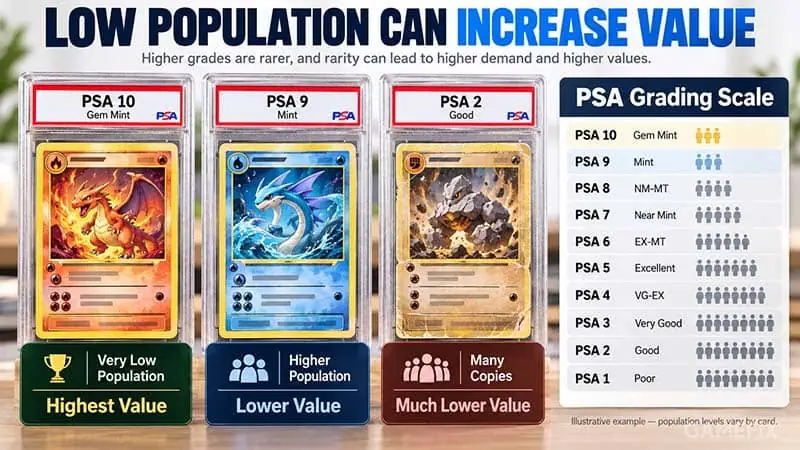
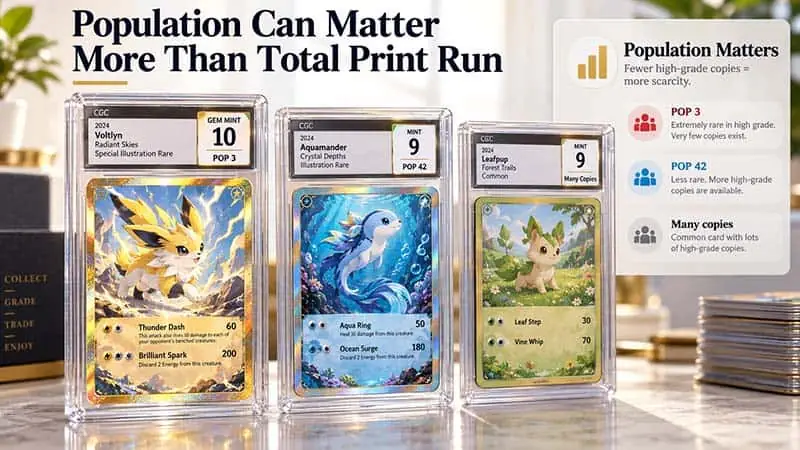
Collectors often talk about a card being “Pop 5” or “Pop 20.” This refers to the number of examples recorded at a particular grade by a grading company.
PSA’s Population Report tracks how many copies of each card it has graded at each level. A low population at PSA 10 can make an already desirable card much harder to obtain in top condition.
However, population numbers need context.
A card might have a low PSA population simply because few people have bothered to submit it for grading. PSA itself warns that population figures do not represent every copy in existence and should not automatically be treated as proof of extreme rarity.
A genuinely valuable low-pop card usually needs something else as well: strong collector demand.
Pikachu and Charizard Have an Advantage
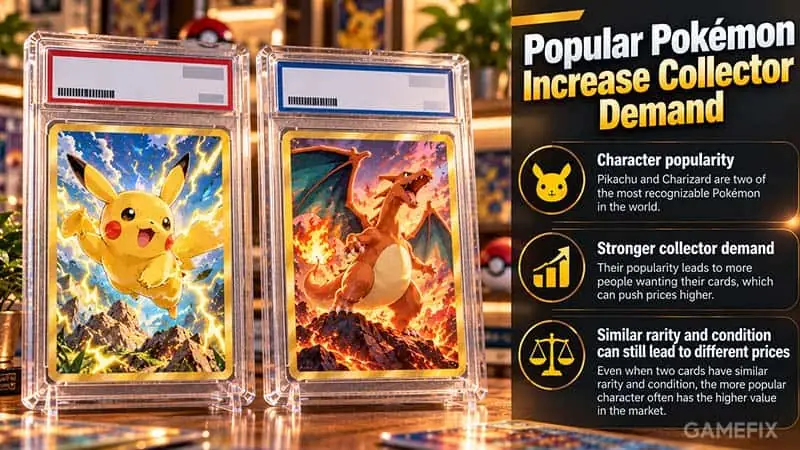
The Pokémon printed on the card matters too.
Pikachu is the face of the franchise. Charizard has been one of the hobby’s most popular Pokémon since the earliest sets. Mew, Mewtwo, Rayquaza, Eeveelutions, and other fan favorites also attract large collector followings.
That creates a simple advantage.
Imagine two cards with similar rarity and condition. If one features a Pokémon wanted by hundreds of thousands of collectors and the other features a character with a much smaller fan base, they are unlikely to command the same price.
This is why rarity alone does not guarantee value.
A card can be extremely scarce and still remain cheaper than a more common Charizard or Pikachu if relatively few people actually want it.
Some Cards Were Never Available in Normal Packs
Distribution history can make a card much more desirable.
Regular set cards are generally obtainable through booster packs or products sold to consumers. Trophy cards, contest prizes, staff cards, tournament rewards, and other promotional releases follow completely different rules.
Some were available only in Japan. Some required winning an event. Others were produced specifically for competitions and never placed into retail packs.
These cards often come with a story attached to them, and collectors are effectively buying a piece of Pokémon history rather than simply another card.
That historical connection is a major reason early tournament cards can command such extraordinary prices.
Difficult Pull Rates Create Modern Chase Cards
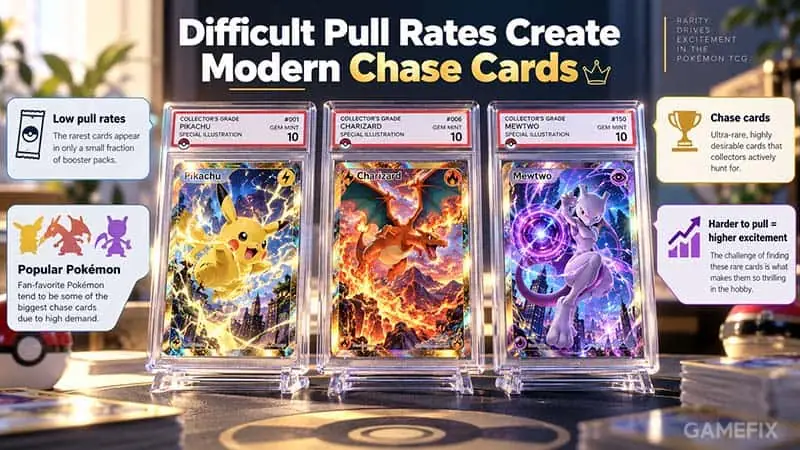
Not every expensive Pokémon card is a competition prize.
Some became valuable because pulling one from a booster pack was genuinely difficult.
Gold Star cards from the EX era are a perfect example. PSA’s research on EX Team Rocket Returns notes that hobby consensus placed Gold Star pulls at roughly one in every 72 packs. A collector could open an entire booster box without finding one.
For some Gold Star sets, estimates vary depending on the release, but the important point remains the same: these were intentionally difficult chase cards.
Years later, that original scarcity combines with another problem. Many cards that were pulled were played with, damaged, lost, or stored poorly. Finding one is difficult. Finding one in Gem Mint condition is considerably harder.
That is how a difficult booster pull can eventually become a six- or seven-figure collectible.
Age Helps, but Age Alone Means Very Little
Older Pokémon cards often receive more attention because many come from the earliest years of the franchise.
However, being from 1999 or 2000 does not automatically make a card valuable.
Common cards were produced in enormous numbers. Many are still easy to buy today. A heavily played vintage card featuring a less desirable Pokémon may therefore remain inexpensive despite being more than 25 years old.
Age becomes important when it combines with other factors.
An early print, popular Pokémon, unusual variation, low surviving population, and excellent condition can create something collectors genuinely struggle to find.
That is when age starts adding serious value.
Artwork and the Artist Can Matter Too
Collectors do not only collect Pokémon species. Many also follow specific artists, illustration styles, promotional releases, or unusual card designs.
Artists such as Mitsuhiro Arita and Atsuko Nishida have deep connections to Pokémon’s visual history. Cards connected to important artists can gain additional appeal, particularly when the release itself is already rare.
Competition cards take this even further. Pokémon Art Academy cards, for example, exist because winning illustrations were turned into actual promotional cards.
In those cases, the artwork is part of the card’s origin story rather than merely decoration.
Grading Also Gives Buyers Confidence
Professional grading does more than assign a number.
The slab identifies the card, records its grade, and provides collectors with an independent assessment of its condition and authenticity. For expensive cards changing hands internationally, that matters.
The popularity of grading itself has also grown enormously. PSA says it graded around two million cards in 2020 and more than 19 million during 2025.
At the high end of the market, collectors often pay significant premiums for top-graded copies. PSA’s own marketplace analysis found that its PSA 10 examples frequently sold above comparable top grades from several competing grading companies in the sample it studied.
This does not mean every PSA 10 is expensive. It means grading can amplify the value of a card that collectors already want.
Why Are Most Pokémon Cards Cheap?
This is the other side people often forget.
Most Pokémon cards are not rare enough or desirable enough to become expensive.
A modern common card may have:
- an enormous print run,
- thousands of near-perfect surviving copies,
- very little collector demand,
- no unusual history,
- and no difficulty obtaining another copy.
Even if the artwork looks great, there is simply no shortage.
That is why opening a booster pack does not mean every card inside has meaningful resale value. Most of the value tends to concentrate around specific chase cards, rare variants, unusual promos, and cards featuring particularly popular Pokémon.
What Actually Makes a Pokémon Card Valuable?
There is no single formula, but the most expensive Pokémon cards usually combine several qualities:
Scarcity, strong demand, excellent condition, a low high-grade population, popular Pokémon, historical importance, difficult distribution, and collector interest.
Remove one of those factors and the price may fall dramatically.
That is why one rare card might sell for $500, another for $50,000, and an exceptional trophy card for several million dollars.
Ultimately, Pokémon cards are worth what collectors are willing to pay. The cards that reach extraordinary prices are usually the ones where very few copies exist in the condition people want, while a very large number of collectors want to own them.

